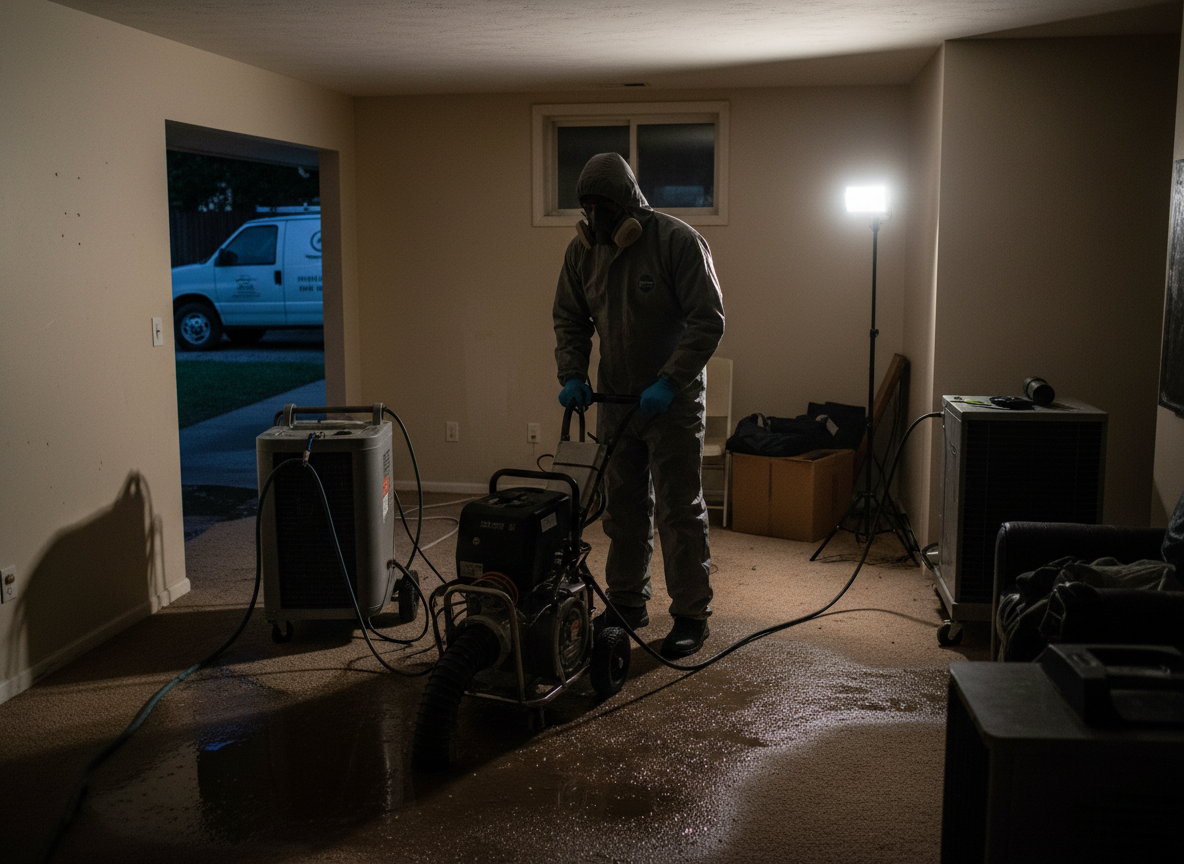
Littlerock sits in a high-desert pocket of Los Angeles County where summer heat can push indoor humidity past 60 percent within hours of a leak, while winter nights dip low enough to freeze supply lines in older single-story homes. When water escapes, it often travels through the sandy alluvial soil near Littlerock Dam before anyone notices, soaking subfloors and sill plates that sit directly on grade. A 24-hour water restoration near me call here usually starts with infrared mapping to find moisture that has already wicked 10 to 15 feet beyond the visible wet spot.
Most homes along Pearblossom Highway and the streets around Littlerock Community Park were built between the 1960s and 1980s with slab-on-grade construction and minimal vapor barriers. That detail changes every job: once water reaches the slab edge it migrates under the concrete and into the drywall bottom plates, creating hidden mold colonies that standard box fans never reach. Our crews pull baseboards the first day, set containment, and run low-grain dehumidifiers sized for the actual cubic footage rather than guessing from square footage alone.
Los Angeles County code requires that any structural drying after a Category 2 or 3 loss be documented with daily moisture logs before drywall can be replaced. We keep those logs on site and share them with insurance adjusters so homeowners avoid the common delay that happens when work stops for missing paperwork. The same desert winds that dry yards in a day can also pull moisture back into a house if windows are left open during extraction, so we seal openings and use negative air machines from the first hour.
Technician insight
In Littlerock, the thing that catches most people out with 24-hour water restoration near me is how the sandy soil around Littlerock Dam lets water travel under slabs for days before it shows up in the living room, especially after a winter freeze.
Slab Leak Near Littlerock Dam
A homeowner on the east side noticed damp carpet after a cold snap. Inspection showed water had traveled under the slab from a supply line. We extracted, dried the subfloor, and kept daily logs until readings cleared.
How it works
- 1
Emergency Dispatch
Answer the call 24/7, confirm the address near Littlerock Dam or Community Park, and roll a truck within the hour.
- 2
On-Site Assessment
Map moisture with thermal imaging, classify the water, and set containment before extraction begins.
- 3
Water Removal and Drying
Extract standing water, place commercial dehumidifiers and air movers, then monitor readings daily.
- 4
Final Clearance and Handover
Verify moisture levels meet industry standards, remove equipment, and provide documentation for insurance.
Pricing
Upfront quotes after inspection; cost moves with water category, affected square footage, and whether slab-edge migration is present.