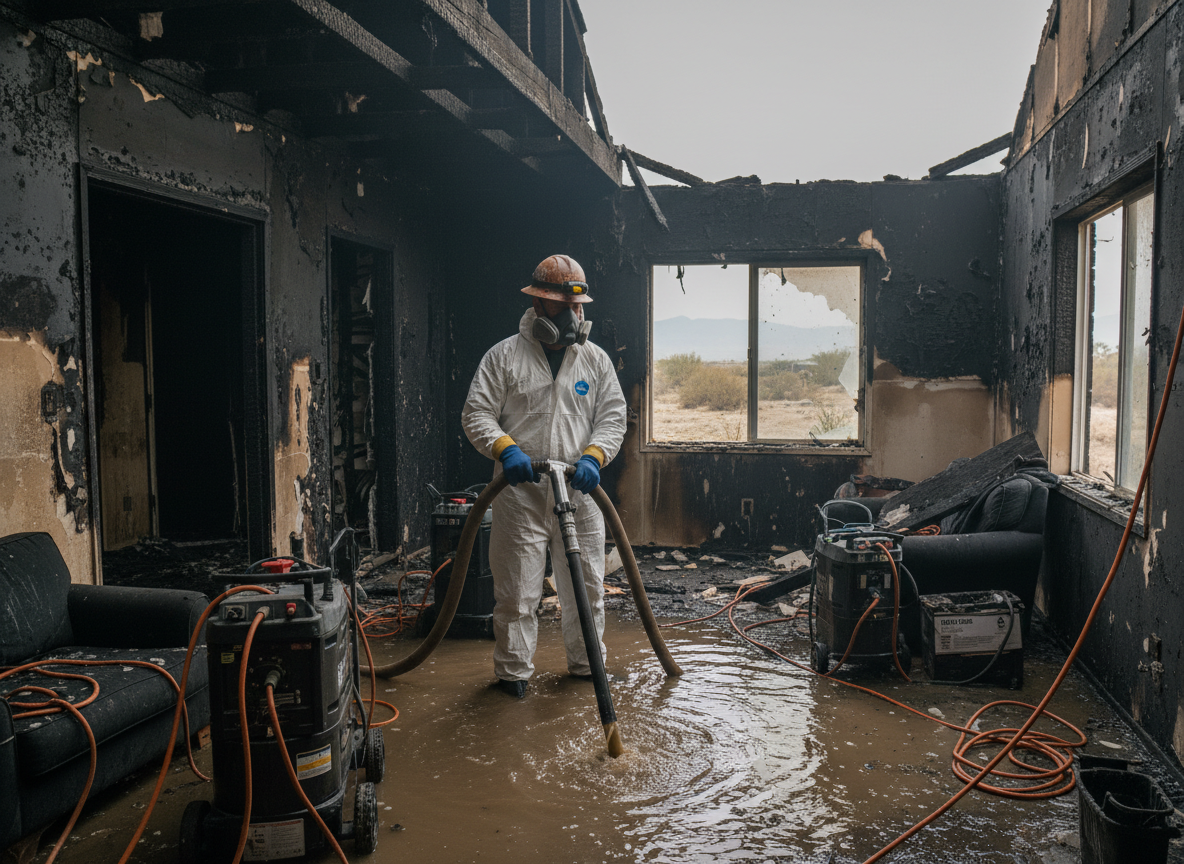
Desert conditions in Littlerock create unique challenges for water damage remediation after fire. Hot summer temperatures accelerate surface drying but trap moisture behind walls and under floors in older single-family homes common throughout Los Angeles County. Cool winter nights slow evaporation and allow residual water from suppression efforts to seep into concrete slabs or crawl spaces near the Littlerock Dam area. Crews must account for rapid soot redistribution driven by afternoon winds that funnel through the Antelope Valley toward Lancaster and Palmdale.
Firefighting water often carries particulates that stain porous materials like drywall and carpet padding found in Littlerock's housing stock. Extraction begins with moisture mapping to locate hidden pockets created when water pools against foundations or flows toward low-lying spots around Littlerock Community Park. Technicians then deploy air movers and dehumidifiers sized for the arid climate, preventing secondary mold growth that thrives once temperatures moderate. Containment barriers protect unaffected rooms while HEPA filtration captures airborne ash before it settles into HVAC systems.
Homes built decades ago along Pearblossom Highway frequently feature mixed materials that react differently to alkaline water from fire hoses. Remediation includes removing saturated insulation, treating affected framing, and drying subfloors before reinstallation. Failure to address these steps allows odors to linger in attics where desert winds push soot through vents. Final verification uses moisture meters to confirm levels match pre-loss conditions typical for the region.
Technician insight
In Littlerock, the thing that catches most people out with water damage remediation after fire is how desert winds push soot deep into attics and wall cavities of older homes near the dam, especially when winter cooling slows drying and lets moisture linger under slabs.
Post-fire water in a Pearblossom home
Suppression water had migrated under the slab of a single-story house east of Littlerock Community Park. Inspection revealed hidden saturation in flooring and insulation that had begun to affect nearby framing. Extraction and targeted drying removed the moisture before odors developed, returning the structure to pre-loss condition.
How it works
- 1
Initial Assessment
Inspect affected areas for water migration paths and soot distribution using meters and thermal imaging.
- 2
Water Extraction
Remove standing water and saturated materials from floors, walls, and cavities.
- 3
Drying and Dehumidification
Apply equipment calibrated for Littlerock's temperature swings to eliminate hidden moisture.
- 4
Soot and Odor Treatment
Clean surfaces and neutralize odors before restoring or replacing damaged components.
Pricing
Upfront quotes provided after on-site inspection at 7704 Pearblossom Hwy.