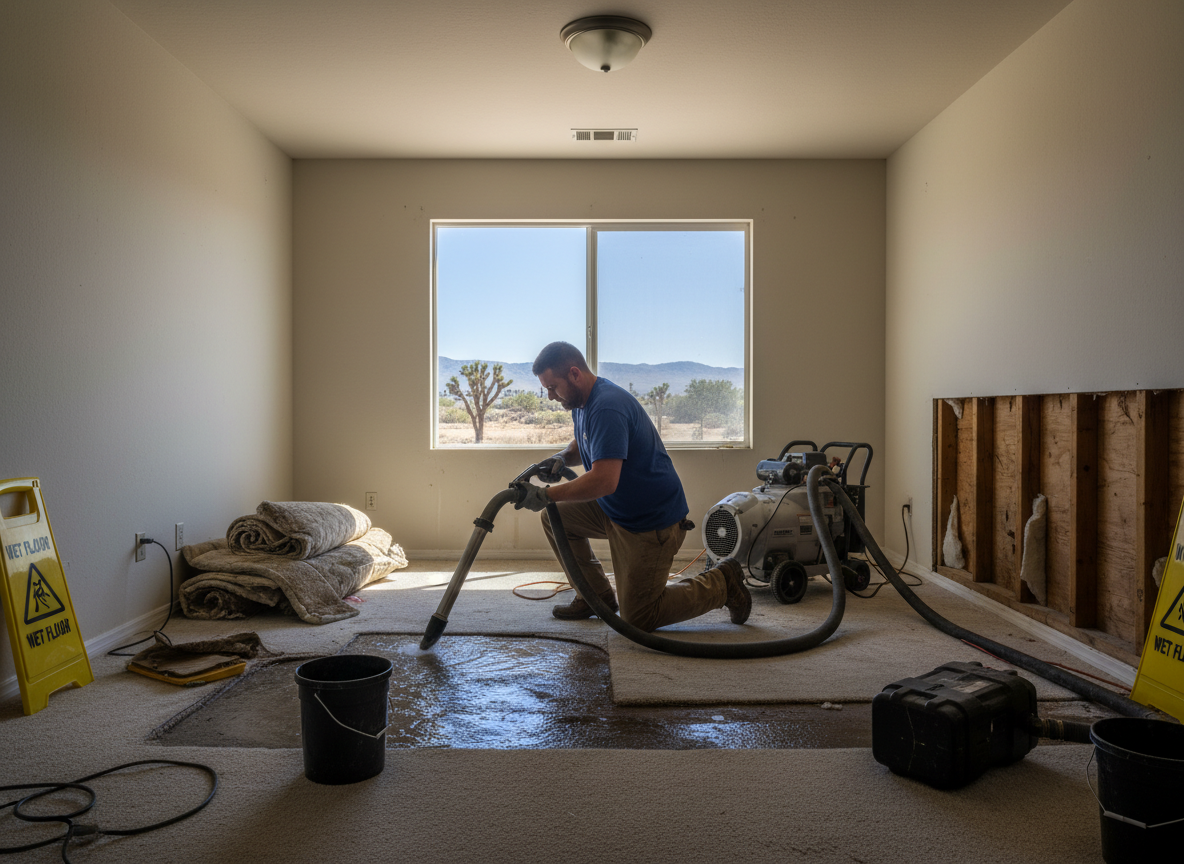
Littlerock sits in the high desert of Los Angeles County where summer heat can push interior moisture out of drywall quickly but also bakes hidden water deeper into older slab foundations common in homes built near Pearblossom Highway. Cool winter rains often arrive in short bursts that pool against the base of structures because the hard-packed desert soil drains slowly. When water reaches the Littlerock Dam area or Littlerock Community Park neighborhoods, crews must account for both flash runoff and the fine silt that travels with it and settles inside wall cavities.
Many houses between Littlerock and Palmdale still have original plaster over wood lath or early particleboard subfloors that absorb water differently than modern materials. Once saturated, these layers hold moisture against framing long after surface water is gone, raising the risk of hidden mold along the cool north walls that stay shaded most of the day. Extraction equipment must be placed to pull air across these planes without stirring up the alkaline dust typical of the region, which can otherwise clog dehumidifier coils and slow the drying process.
Technicians working near Lancaster Road know that cool winter nights drop temperatures fast enough to push dew points inside affected rooms, so drying plans include heaters timed to the daily cycle rather than constant high heat that can crack older stucco. Edge cases include water that travels under the concrete aprons around mobile homes common in the area, requiring perimeter trenches and targeted air movers rather than whole-room drying alone.
Technician insight
In Littlerock, the thing that catches most people out with water damage restoration near me is how the alkaline desert soil around the base of older homes near the dam holds moisture against the slab edges long after the visible water is gone, so you have to trench and dry from below instead of just running fans inside.
Winter Runoff Under Home Near Littlerock Community Park
Heavy rain sent water across the park and under a 1970s home on Pearblossom Hwy. We found moisture trapped in the subfloor and along the north foundation wall. Extraction and perimeter drying removed the water without disturbing the original plaster. The home dried evenly within four days.
How it works
- 1
On-Site Assessment
Technician inspects all affected rooms, checks moisture levels in walls and floors, and notes any paths water may have taken toward the foundation near Littlerock Dam runoff zones.
- 2
Water Extraction
Remove standing water with truck-mounted pumps and portable units suited for desert silt that can clog standard equipment.
- 3
Drying and Dehumidification
Place air movers and dehumidifiers on a schedule that matches daily temperature swings between hot afternoons and cool nights.
- 4
Final Moisture Check and Hand-Off
Verify all materials return to normal moisture content and document conditions for the homeowner before equipment removal.
Pricing
Pricing varies by the amount of water, materials affected, and time required to dry older construction common in Littlerock.